Most Businesses Don’t Have a Profit Problem—They Have a Visibility Problem
- Ledger Lions
- Jun 23, 2026
- Virtual CFO Services

Every business owner knows their sales number. It’s the metric celebrated in team meetings, plastered on pitch decks, and tracked with daily enthusiasm. Most owners also know exactly how much cash is sitting in the bank right now.
But if you strip away those two surface-level numbers, surprisingly few leaders can instantly answer the questions that actually dictate a company's survival:
- Which specific product line or service contract generates our highest net profit?
- Which customer profile genuinely contributes to our cash flow, and which ones drain it?
- How much working capital is currently trapped in aging receivables?
- What will our exact cash position look like 90 days from now?
- Which operating expenses are quietly scaling faster than our top-line revenue?
When these questions go unanswered, it isn't due to a lack of ambition or effort. It is the direct result of a financial visibility problem.
The Hidden Cost of Operating in the Dark
Many growing companies manage their operations through "bank-balance accounting" – making critical hiring, inventory, and capital decisions based purely on intuition or a quick glance at their current checking account.
At the startup phase, this might feel manageable. However, as a firm grows bigger, small blind spots become catastrophic and costly mistakes. To avoid these pitfalls, implementing professional Accouting outsourcing services early on ensures your financial foundation remains rock-solid. Working without complete clarity of the financials, some symptoms manifest:
- The Growth Dilemma: Suffering from unexpected and frightening cash crunches amid record sales numbers.
- Compliance Crisis: Being stressed about meeting the end-of-month/end-of-quarter deadlines for payment of GST, TDS, and corporation tax, which is a liability that was not calculated in real time.
- Margin Crisis: Seeing costs go up while no one is responsible for the same.
- Fundraising Crisis: Getting refused bank loans or venture funding due to unorganized/unvouched historical data.
These foundational cracks are rarely caused by a bad product, a weak sales team, or a lack of market demand. They happen because the executive team is flying a complex aircraft without an instrument panel.
The Dangerous Myth: Revenue Equals Profit
One of the most persistent, damaging misconceptions among ambitious entrepreneurs is the belief that a rising revenue curve cures all ills. The assumption is simple: If we sell more, we will make more.
In reality, rapid revenue growth without tight financial controls is a fast track to insolvency. Higher sales numbers almost always trigger a massive domino effect:
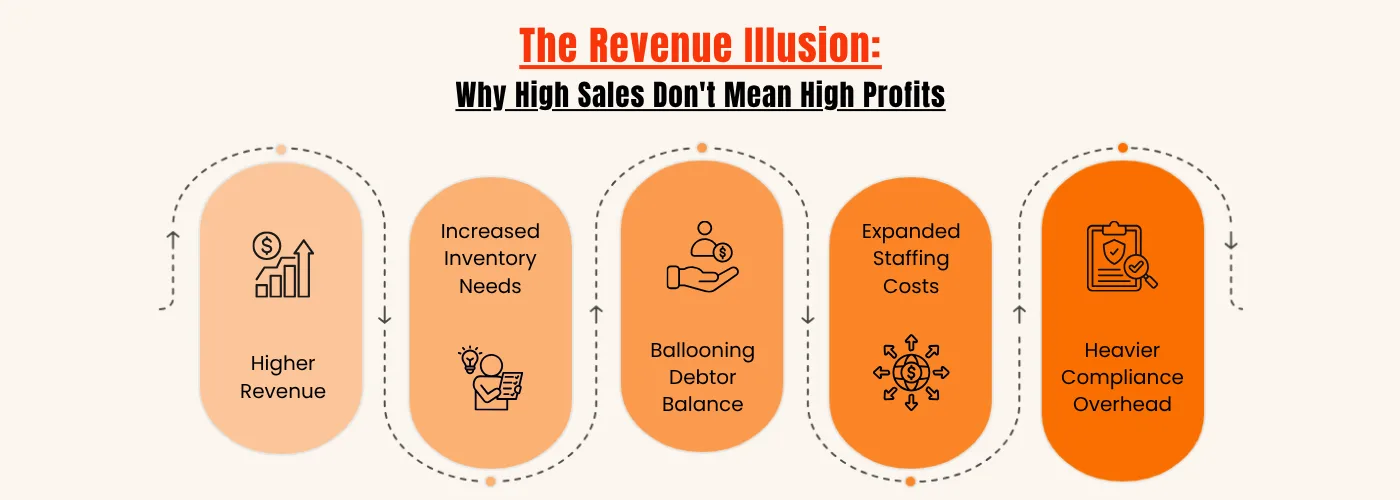
Without rigorous, proactive monitoring, a company can easily experience its highest-grossing sales quarter while simultaneously sliding into a severe cash flow crisis. True financial visibility shifts your focus away from superficial top-line vanity metrics and anchors it firmly onto sustainable bottom-line health.
Deconstructing True Financial Visibility
Financial visibility is not merely the act of filing your taxes on time or handing a shoebox of receipts to an accountant at the end of the year. It is the real-time capability to understand your business’s exact current standing and projected future position at any given moment.
To achieve true clarity, a business must integrate five core pillars:
- Granular Cash Flow Tracking
Moving beyond historical bank statements to map exactly where capital is originating, where it is being deployed, and when it will return.
- Actionable MIS (Management Information Systems) Reporting
Transforming raw, backwards-looking accounting ledgers into forward-looking business intelligence that guides daily operations.
- Profitability Analysis In-Depth
The ability to sift through information to understand which customers, delivery strategies, or geographical segments are making money—and which are quietly being supported by the others.
- Working Capital Management Dynamically
Finding the optimal balance among inventory, accounts payable (AP), and accounts receivable (AR), which is complex and highly sensitive to change.
- Compliance Systematically in Advance
Setting up your business to systematically record all your tax obligations (GST, Income Tax and ROC) as you go, avoiding any nasty surprises at year-end.
When these systems operate in harmony, business leaders transition from a state of constant, stressful firefighting to strategic, data-driven prevention.
Why Standard Accounting Software Isn't Enough
When confronted with visibility gaps, the typical reaction is to buy a new software subscription. However, the root issue is rarely the choice of technology. Most enterprises already own functional accounting tools.
The real breakdown happens because the data driving those systems is consistently
- Delayed: Transactions are logged weeks after they occur, making the data irrelevant for real-time decisions.
- Incomplete: Out-of-pocket expenses, accrued liabilities, and committed costs are missing from the active dashboard.
- Misclassified: Expenses are dumped into generic categories, completely obscuring where operational bloat is happening.
- Unreviewed: Data is accumulated strictly for compliance rather than being translated into strategic insights.
The Golden Rule of Corporate Finance: Accounting entries alone do not create business intelligence. The true value lies entirely in the translation of raw data into strategic execution. This is where expert accounting services step in, structuring your daily data so it becomes an asset, not just a compliance chore.
Enter the Virtual CFO: Strategic Leadership for Growing Brands
A mid-sized or rapidly growing Indian business often finds itself caught in a tough financial paradox: it desperately needs high-level corporate governance to scale, but it cannot yet justify the hefty ₹30–50 Lakh annual salary of a seasoned, full-time Chief Financial Officer. A Virtual CFO bridges this strategic gap perfectly.
Through working together with a fractional finance expert, your company is guaranteed top financial expertise at a much lower price point thanks to:
- Predictive Financial Engineering: They go beyond looking at previous scorecards and help create well-structured budgets as well as predictive 90-day cash flow modeling.
- Unit Economics Optimization: They conduct a thorough analysis of cost structures to ensure that your net margins don’t get lost in operational cracks.
- MIS Systems Framework: They turn your basic accounting software like Tally or Zoho Books into custom-built management information systems for faster decision-making.
- Growth Strategy Assistance: They offer you all the necessary financial information and compliance to pass through investor due diligence or bank financing.
The Essential Monthly Financial Playbook
To regain total control over your trajectory, ensure your leadership team reviews these five foundational reports at the close of every single month:
| Report Type | Operational Purpose | Executive Insight Gained |
| Profit & Loss (P&L) | Evaluates structural operational health. | Tells you if your business model is fundamentally sustainable and generating a real surplus. |
| Rolling Cash Flow Forecast | Tracks liquidity pipelines 30/60/90 days out. | Can preempt cash shortages way before it affects the payroll or relationships with suppliers. |
| AR Ageing Report | Helps in identifying slow payers or defaulters. | Shows you exactly where your money is getting delayed and where collection terms need to be applied. |
| Working Capital Dashboard | Determines the liquidity efficiency. | Shows you how much working capital is stuck in your inventory. |
| Consolidated MIS Dashboard | Condenses non-financial and financial KPIs. | Gives an instant, comprehensive snapshot of organizational velocity and departmental efficiency. |
The Ultimate Competitive Advantage
In today’s break-neck Indian market environment, your ability to react quickly and accurately will determine your existence. Those companies that can make decisions based on accurate and timely financial information will be able to adapt immediately, making financial information a powerful tool of operation:
- Proactive Response: Identify a declining margin in any product line within days instead of finding out about it weeks later through future quarterly reports.
- Strategic Advantage: Obtain favorable credit arrangements from suppliers, access cheaper loans from banks, and invest money with total assurance.
- Risk Elimination: No need to respond to unforeseen financial shortages that could have been easily avoided months ago.
The primary differentiator between industry leaders and companies that quietly plateau isn’t hard work or product quality—it comes down to who has the better dashboard. Financial clarity eliminates the uncertainty that brings worry and gives you the upper hand on your competition that is still trying to figure out what’s happening in their bank account.
Conclusion
Sustainable business success is not based solely on powerful sales pitches or marketing. It comes from making smart decisions based on knowledge. If you are running your operations based entirely on your current bank balance, you aren't managing growth—you are simply managing uncertainty.
The ultimate goal of your accounting infrastructure should never be limited to year-end compliance or avoiding tax penalties. It should exist to provide absolute strategic clarity. When you truly understand your numbers, your risk decreases, your teams become more accountable, and your path to profitability becomes obvious. Stop flying blind. Bring financial visibility to the core of your business strategy, and watch your business transform from a stressful firefighting operation into a predictable, scaling engine.
