What’s Included in Outsourced Accounting Services in India? Bookkeeping, GST, TDS, and Financial Reporting
- Ledger Lions
- Oct 26, 2026
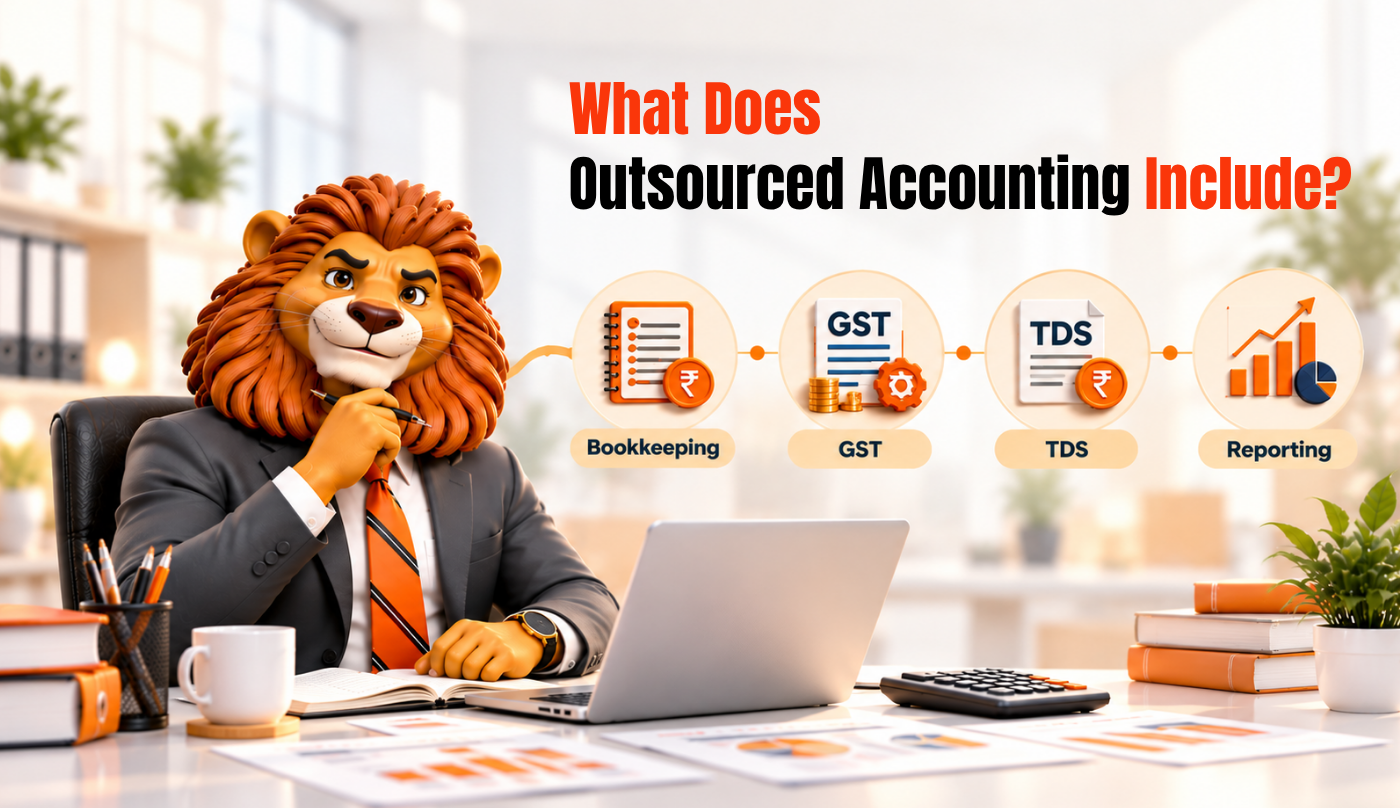
India‘s finance and accounting outsourcing industry commands over 52% of the global market share, with costs running 40-70% lower than Western markets. For businesses drowning in transaction-level work, invoice entry, GST reconciliations, and TDS computations, this cost differential is real. But the critical question isn’t the price. It’s this: what exactly lands on the provider’s desk once you sign?
This blog breaks down the precise deliverables inside outsourced accounting services, which cover everything from daily bookkeeping to monthly compliance cycles, so you can scope the engagement correctly before committing.
Key Takeaway
- Outsourced bookkeeping services in India can cover much more than basic transaction entry.
- Depending upon the decided scope of work, assistance can be provided for maintaining transaction entries, GST, TDS, reconciliations, accounts payable/receivable, preparing financial statements, and maintenance of your records.
- One must always make sure that one is aware of what is being offered, how many times, and by whom before proceeding with outsourcing of any process.
What Are Outsourced Accounting Services in India?
Outsourced accounting services in India consist of outsourcing accounting tasks along with bookkeeping and GST/TDS assistance. As against the cost involved in hiring an in-house accountant (salary ranging from ₹25,000 to ₹45,000 plus PF and gratuity), outsourcing is based on a flat fee per month. You pay for output, not headcount. The provider carries the staff, the software license, and the continuity during leave cycles.
For India-registered entities, the appeal extends beyond cost. India‘s GST and TDS regimes involve recurring compliance deadlines. TDS payment is generally due by the 7th of the following month, while GST filing deadlines vary based on the taxpayer and filing frequency. Miss a date, and penalties compound. An outsourced team builds these rhythms into their workflow by default.
The range of providers is wide. You've got solo CAs working from a home office. You've got mid-sized firms. And you've got structured operations offering accounting outsourcing services with dedicated teams, review layers, and cloud software built into the package.
What Is Included in Outsourced Accounting Services?
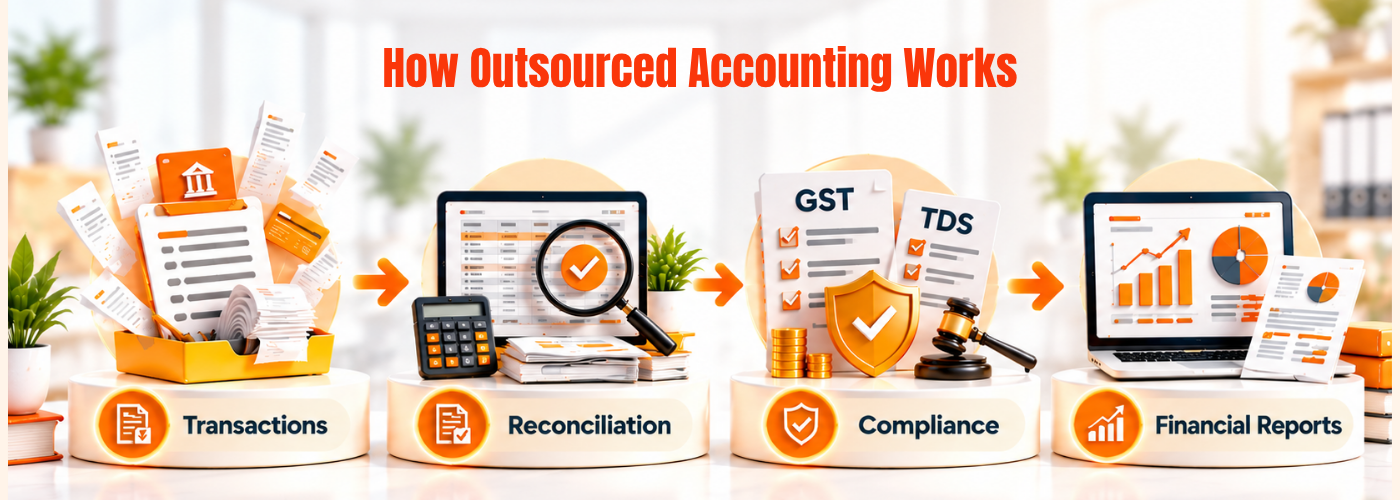
Most providers structure their deliverables around four recurring pillars. Expect variation in depth, but these components form the baseline.
Bookkeeping and Bank Reconciliation
Sales invoices, purchase bills, bank ledger, cash ledger, voucher entry, and vendor and customer management.
Most providers of outsourced bookkeeping services would provide daily or weekly data entry along with monthly bank reconciliation for accuracy in your accounting ledgers to tally with that of the bank statement.
It forms the basis of other tasks covered by bookkeeping services in India, such as GST returns, TDS computation, and management reporting.
GST Compliance and Return Filing
GST compliance and filing can be bifurcated into monthly and annual obligations. Monthly GST work can include GSTR-1, GSTR-3B, and reconciliation of purchase records with GSTR-2B to identify possible ITC mismatches.
Depending on eligibility and applicable requirements, annual compliance may include GSTR-9 and, where applicable, GSTR-9C. The important operational detail is that reconciliation needs to be done prior to GSTR-3B filing and not post, otherwise there will be an accumulation of ITC issues at year-end.
TDS Computation and Return Filing
TDS obligations arise in respect of professional fees, rent, contractors, commissions, and many others. TDS calculations by transaction types, TDS deposit with the government by the 7th, and filing applicable TDS statements quarterly.
Speaking of any trusted outsourced accounting provider in India, it should ensure that every expense ledger is checked for TDS applicability instead of just cross-checking the bank debits, since timing and nature of payment matter.
Financial Reporting and MIS
Monthly MIS packs include a trial balance, profit and loss, balance sheet, aged receivables and payables, and often a management commentary with variance analysis.
Some providers offer CFO-level services, cash flow forecasting, budget-to-actual comparisons, and KPI dashboards.
The depth depends on your retainer tier. A basic plan delivers statements, and a premium plan delivers interpretation.
| Deliverable | Frequency | Key Output |
| Bookkeeping & Bank Reconciliation | Daily/Weekly/Monthly | Updated ledgers, reconciliation statements |
| GST Compliance Support | Monthly | Filed returns, ITC reconciliation report |
| GST Annual Returns | Annually | GSTR-9/9C filing |
| TDS Computation & Payment | Monthly | TDS payment tracking and challan support. |
| TDS Returns | Quarterly | Filed returns, Form 16/16 A issuance |
| Financial Reporting & MIS | Monthly/Quarterly | P&L, Balance Sheet, cash flow, KPI reports |
What Does a Typical Monthly Outsourced Accounting Cycle Look Like?
An average monthly process for accounting outsourcing can go as follows.
- Data Gathering: All the invoices and other necessary data will be supplied by the client himself.
- Bookkeeping: The entries in the books of accounts are recorded through journal entries.
- Reconciliation: It includes bank reconciliation, ledger reconciliation, supplier reconciliation, and customer reconciliation.
- GST and TDS check: The tax details will be verified depending on the scope of work decided upon.
- Adjustments: Entries that were missed will be adjusted and all the differences will be sorted out.
- Reports: Preparation of financial reports or MIS reports.
- Review: Issues are pointed out by the accounting team to the management.
The actual process could vary depending on the size of the client and the accounting software used, along with the scope of the service.
How to Choose an Outsourced Accounting Provider
- First: what counts as a “transaction” in the pricing band? A vague quote of “up to 300 entries” without defining whether bank entries and journal vouchers count separately invites scope creep.
- Second: who reviews the work? Junior data entry clerks make errors a CA-reviewed output layer catches them.
- Third: what software do they operate on? Tally, Zoho Books, QuickBooks, and Busy are standard. Confirm your provider works on the platform you prefer or supports migration.
Final Thoughts
The scope of outsourced accounting services in India is narrower than “handling your finance function” and broader than “data entry". It sits precisely at the intersection of recurring transaction processing and statutory compliance, the work that consumes hours every month without generating strategic value. Knowing exactly which deliverables sit inside the retainer and which are add-ons turns a vague outsourcing decision into a measurable engagement.
If you want a provider who treats TDS computation, GSTR-2B reconciliation, and bank reconciliation as non-negotiable monthly disciplines rather than optional extras, start there.
FAQs
1. What are the general services that are covered under outsource accounting services in India?
In India, Accounting outsourcing companies typically provide services such as bookkeeping, bank reconciliation, GST compliance, TDS calculation, Accounts payable and receivable, and financial reporting. The specific services provided will depend on your business needs and the scope of work you agree with your provider.
2. Is it more cost efficient to outsource accounting as opposed to having an in-house accountant?
For many businesses it’s cheaper to outsource than to employ a full-time accountant. You can save on recruitment, employee benefits, accounting software and training, while benefiting from a team with relevant accounting and compliance experience.
3. Can a small business outsource bookkeeping service and GST filing?
Yeah. Bookkeeping and GST Filing for small businesses from one provider these tasks, when kept connected, can assist in transaction matching, identification of input tax credit discrepancies and filing of GST returns with the help of live accounting records.
4. How often will an outsourced accounting service provider give me financial reports?
Most providers will provide financial reports monthly, but it is contingent upon your agreement. These reports can include your profit and loss statement, balance sheet, cash flow summary and outstanding customer or supplier balances to help you keep track of business performance.
5. What to consider before choosing an outsourced accounting service provider in India?
Make sure that you have an idea about the types of services provided in the monthly charge, frequency of updating your books, reviewing process of the work, and whether GST and TDS compliances are offered or not. You should also ask about the accounting software used for the process.
