Outsourced Accounting vs In-House Accounting: Which Is Better for Indian Businesses?
- Ledger Lions
- Sep 29, 2026
- Accounting
Everyone tells you outsourcing accounting services is risky. That someone outside your office won't care about your money the way you do. Fair concern. But here's what nobody mentions: your in-house accountant resigned last month, and you still haven't found a replacement.
Meanwhile, GST deadlines are still approaching. So before you decide that in-house is automatically safer, let's look at what both options actually cost you in rupees, in time, and in sleepless nights.
This blog compares outsourced accounting vs in-house accounting honestly, including the parts most firms won't tell you.
Key Takeaway
- Neither option wins every time. In-house accounting suits businesses with steady volumes and strong finance leadership.
- Outsourced accounting services suit businesses that need flexibility, wider expertise, or simply can't afford a full team.
- Many Indian businesses use a mix of both. What matters is matching the model to your stage, not following what some competitor did.
What Are Outsourced Accounting Services?
Strip away the jargon, and it's simple: you pay an outside firm to handle your books, compliance, and reporting.
For an Indian SME, that usually covers bookkeeping, GST returns, TDS, payroll with PF and ESI, bank reconciliations, vendor payments, and monthly reports you can actually read. Some firms also handle income tax, audits, and ROC filings.
The range of providers is wide. You've got solo CAs working from a home office. You've got mid-sized firms. And you've got structured operations offering accounting outsourcing services with dedicated teams, review layers, and cloud software built into the package.
Pricing varies just as much. In some cases, pricing can start around ₹8,000–₹15,000 a month for basic bookkeeping, depending on the provider and workload. Add payroll, GST, and reporting, and you're looking at ₹25,000–₹60,000 a month depending on transaction volume. Compare that to a senior accountant's CTC in a metro, and the math gets interesting fast.
One thing worth saying plainly: outsourced bookkeeping services in India has matured significantly. The days of couriering dusty ledgers to a CA office are largely gone. Most serious providers work on cloud platforms with real-time access.
What Are In-House Accounting Services?
This is the traditional setup. You hire accountants. They sit in your office. You pay salaries, PF, ESI, bonuses, and software licenses.
The obvious upside is proximity. You can walk over and ask why a payment was coded a certain way. Your accountant knows your vendors by name, understands why that one client always pays late, and remembers the mess from two years ago.
That context is genuinely valuable. Don't let anyone tell you otherwise.
But there's a flip side nobody advertises. One person handling everything means one point of failure. If your accountant is on leave during a GST filing week, who files? Hiring takes weeks. Training takes months. And the new person still won't know your business the way the old one did.
There's also a ceiling problem. Accounting outsourcing services can also give you broader expertise. One in-house accountant may not have deep expertise across GST, payroll compliance, TDS, financial reporting, and Ind AS. At some point, you're paying for breadth you're not getting.
Comparison of Outsourced Accounting vs In-House Accounting
| Factor | Outsourced | In-House |
| Monthly cost | Variable, typically ₹15,000–₹60,000+ for SMEs | Salary + benefits + software + workspace are often higher for equivalent skill |
| Scaling up | Add volume, adjust fee | Hire, train, wait |
| Scaling down | Reduce scope or pause | Layoffs. Unpleasant. |
| Expertise | Team with varied exposure | Limited to who you hired |
| Business context | Needs deliberate handover and communication | Built naturally over time |
| If someone quits | Provider absorbs it | You absorb it |
| Compliance accuracy | Process-driven, usually reviewed twice | Depends on one person's diligence |
| Response speed | Structured; not instant | Walk over and ask |
| Software & security | Provider's responsibility | Yours |
| Best suited for | Growing SMEs, fluctuating volumes, lean teams | High-volume, complex, stable operations |
When Is Outsourced or In-House Accounting Better?
Go In-House If:
Your transaction volume is high and steady. You've got enough work to keep two or three people genuinely busy. You have a finance manager who can supervise and review. And your operations are complex enough that explaining them to an outsider would take months.
For instance, if you operate in a highly sensitive sector, in-house accounting may give you tighter control. That said, reputable outsourced bookkeeping providers in India can also use NDAs, access controls, and secure systems to protect financial data.
Go Outsourced If:
You're an SME without the budget for a proper finance team. Compliance is eating your weekends. You need skills like Ind AS or international reporting that are hard to hire for locally. Your workload spikes and dips. Or you're simply tired of the hiring cycle.
This is where outsourced accounting services India earn their keep. You may get access to bookkeeping, review, and compliance expertise without building a full internal team.
One pattern worth noting: a lot of Indian SMEs approach outsourcing firms right after a tax notice or a penalty. That's reactive. It can solve the immediate problem, but it is often expensive and stressful.
What About a Hybrid Accounting Model?
Many mid-sized Indian businesses use this model, and it deserves more attention. The structure looks like this: you keep one or two people in-house for approvals, vendor coordination, and day-to-day context. The outsourced team handles processing, reconciliations, GST, payroll, and reporting.
The failure mode is predictable. Responsibilities blur. The in-house person assumes the outsourced team is handling something. The outsourced team assumes the opposite. Data sits in two places. Nobody reconciles. You end up with the costs of both models and the benefits of neither.
If you go hybrid, write down who owns what. Review it quarterly, and when you're evaluating outsourced accounting for a small business, ask upfront how they handle split-responsibility arrangements. The good ones have a clear answer. The rest will waffle.
Which Accounting Model Should You Choose?
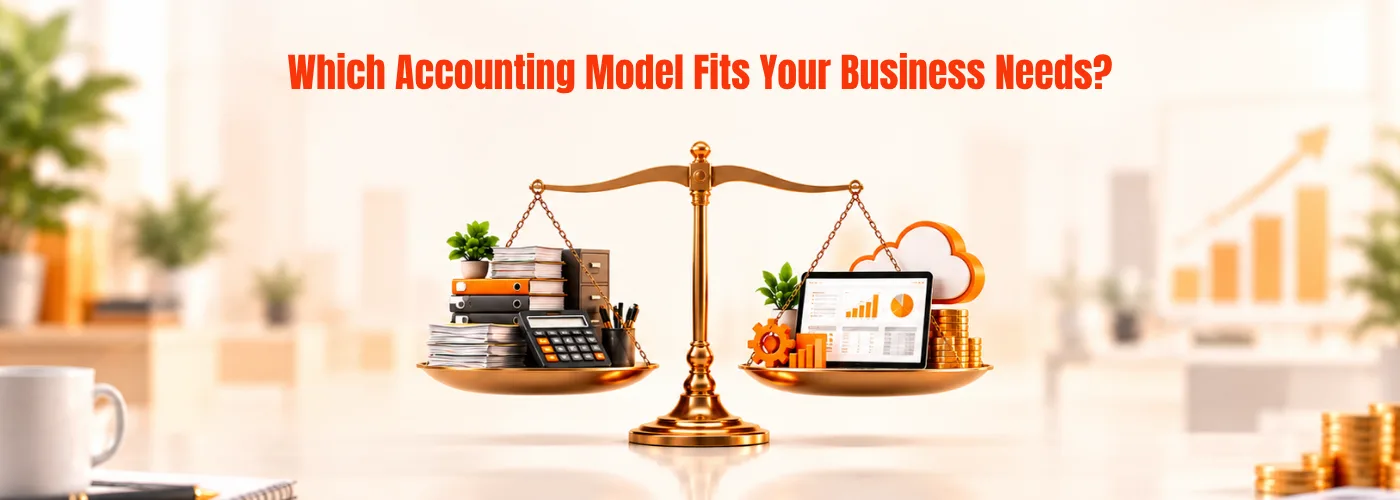
Forget the generic advice floating around online. If you're weighing outsourcing accounting services, ask yourself these five questions and answer them honestly.
How predictable is your workload?
If it changes month to month, outsourcing may offer more flexibility. If it stays consistently high, an in-house team may make more sense.
What's your actual cost?
Not just salary. Add PF, ESI, bonus, software, laptop, desk space, recruitment fees, and the cost of the weeks you spend hiring when someone leaves. Then compare.
What happens if your accountant quits tomorrow?
If the honest answer is "we're stuck," you have a concentration risk problem. Outsourcing spreads that risk.
Are you spending your time on compliance instead of growth?
If yes, that's a signal.
Do you need expertise you can't hire?
A single in-house accountant won't cover Ind AS, complex GST positions, and payroll compliance equally well. A firm can.
How to Choose the Right Outsourced Accounting Provider
A few things that actually matter, based on what goes wrong in practice.
Check who does the work
Some firms pitch with senior CAs and then assign your file to a junior who joined last month. Ask directly: who's on my account, and who reviews it?
Ask about data security
ISO 27001 certification can be a useful signal of structured information security practices. So is whether they use role-based access and secure portals. If they're still emailing Excel sheets back and forth, that tells you something.
Look at their software
Whether they use QuickBooks, Xero, Zoho Books, NetSuite, or another platform, you should have clear and timely visibility into your accounts. You shouldn't have to wait until month-end to know where you stand.
Understand the pricing triggers
What's included? What costs extra? What happens if your transaction volume doubles? Get it in writing.
Test the communication
Ask how often you'll get reports, what the escalation path is, and who responds when something urgent comes up. Vague answers now become real problems later.
If you're in a metro, you'll find no shortage of options. The best accounting firm for one business might be a poor fit for another. It depends entirely on your industry, size, and what you need handled.
Final Words
There's no universal right answer here. A ₹2 crore manufacturing business and a ₹40 crore services company can need very different setups. The mistake is picking a model because it's fashionable or because your competitor did it.
The truth is, most Indian businesses don't choose outsourced accounting services or in-house hiring from a strategy document. They do it because something forced their hand a resignation, a notice, a busy season gone wrong. Step back and look at your numbers. What does your finance function actually cost, including the hidden parts? What breaks when one person is unavailable? Answer honestly, and the right model usually becomes obvious.
